Heavy rain threat looms from Thursday
Read the full story at Kathmandu Post
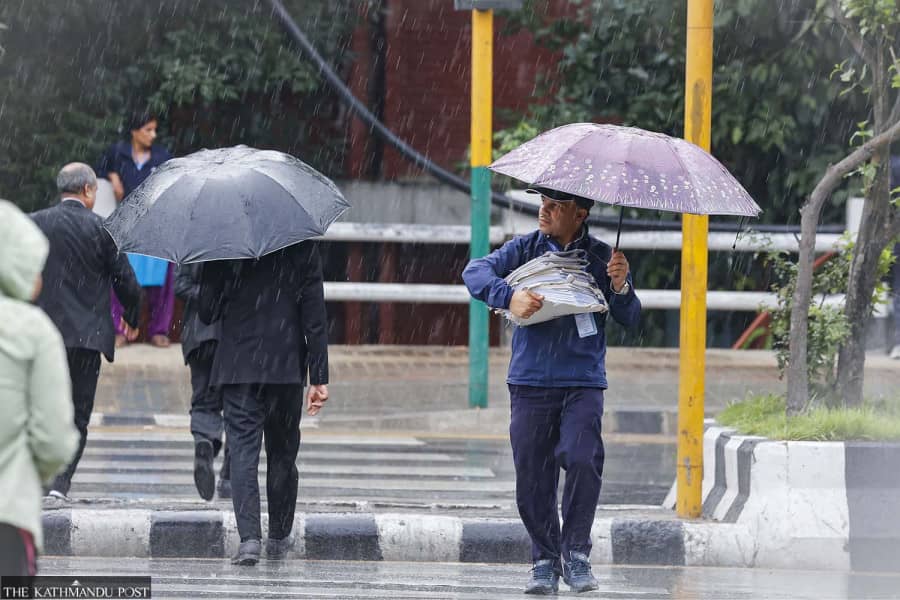
Meteorologists have warned of potentially heavy rainfall across Nepal from Thursday and urged people to remain alert as a weather system develops over the Bay of Bengal. According to the Meteorological Forecasting Division of the Department of Hydrology and Meteorology, Nepal is currently under the partial influence of both the monsoon and westerly winds. The monsoon trough remains south of its normal position. A low-pressure area has formed over the northern Andaman Sea and adjoining areas and is expected to strengthen and move west-northwest, the division said. Binod Pokharel, an associate professor at the Central Department of Hydrology and Meteorology at Tribhuvan University, said several forecast models point to the possibility of exceptionally heavy rain. “After looking at several forecast models, the probability of heavy rain appears high. Some models show more than 400 millimetres of rain, with one showing as much as 741 millimetres,” Pokharel said in a social media post.
“That is an enormous amount of rain. It could fall across many parts of Nepal or in just a few places, but either way, the consequences could be serious.” The influence of a system developing over the Bay of Bengal is expected to increase from September 24 to 28, potentially bringing substantial rainfall to Nepal. Meteorologists expect the system to overlap with a westerly weather system. If the two systems reinforce each other, rainfall could become more intense as they draw moisture towards Nepal. Its influence could increase weather activity over the Bay of Bengal and send more monsoon moisture towards Nepal, meteorologists said. Sanjib Adhikari, a meteorologist at the Meteorological Forecasting Division, said the eastern system could interact with the weather system to the west. “Based on the initial track, there is a possibility of very heavy rainfall in Sudurpaschim and central Nepal,” Adhikari said.
He urged people to monitor weather information and take precautions as the situation develops. Pokharel likewise said it remained uncertain whether the system would develop into a cyclone, but the threat of heavy rain in Nepal remained. He said many areas could receive repeated spells of heavy rainfall from east to west. Nepal’s monsoon normally withdraws around October 2. Adhikari said the current weather pattern could keep the monsoon active until around that date. Last year, the monsoon withdrew from Nepal much later.
This is a short excerpt. EkJhalak links out rather than reproducing other newsrooms’ work — continue at Kathmandu Post.
More politics
- Flames, smoke seen near Riyadh airport; Houthis claim attacks on Saudi capitalKathmandu Post
- Ed Sheeran says he made ‘mistakes’ amid Macklemore controversyKathmandu Post
- Fiction: The making of a revolutionKathmandu Post
- Lumbini Lions to face Sudurpaschim Royals in NPL openerKathmandu Post
- Can ‘Mission 2026’ finally deliver Nepal its first Asian Games gold?Kathmandu Post
- Constitution review mired in political debate as parties fail to agree on scope of amendmentKathmandu Post